Here is an Assembly especially close to my heart. I had the privilege of helping the European Commission’s Joint Research Centre (JRC) design the Young Citizens’ Assembly on Pollinators, and later served as a knowledge source during the Assembly itself. One of the ideas I was invited to present was the possibility of creating a Permanent European Youth Assembly for Biodiversity—a standing democratic institution able to accompany Europe’s ecological transition over time, ensuring that young people are not consulted only once but become enduring democratic custodians of our living commons.
I am delighted to share a short video that Daphne and I developed to accompany this initiative. We tried to capture both the spirit of the Assembly and the democratic promise it represents, to inspire our collective belief in citizen deliberation’s power to reconnect people, nature and European democracy.
This idea has become an important thread in my own work on democratic innovation, transnational democracy and the long-term stewardship of our common goods. It became a natural companion to The Democratic Odyssey: while the Odyssey has explored since 2023 how citizens can deliberate as part of an itinerant assembly on how to democratise the management of crisis, the Pollinators Assembly demonstrates how this democratic imagination can be rooted in the stewardship of the living world. And while the Odyssey’s pilot Assembly combined a bottom up and soft top-down mandate, the Pollinators Assembly was a direct emanation of the European Parliament.
The Assembly brought together one hundred young Europeans to deliberate on one of the most urgent, yet often overlooked, challenges of our time: the decline of pollinators, whose survival underpins biodiversity, food systems and the resilience of our ecosystems. It was a remarkable demonstration of what happens when young citizens are trusted with complexity and given the space to deliberate across borders. Their work resulted in a thoughtful and ambitious set of recommendations, accompanied by detailed explanations of the reasoning behind each proposal.
This achievement is also a tribute to the vision and commitment of the European Commission’s Joint Research Centre (JRC) under the guidance of Mateusz Tokarski and Angela Guimaraes Pereira and DG Environment. Together, they have shown how scientific expertise, democratic innovation and public policy can reinforce one another. Rather than treating citizen participation as an add-on to environmental policy, they have helped make it part of policymaking itself. I remain deeply grateful for their openness to experimentation and for demonstrating that European institutions can themselves become laboratories of democratic innovation.
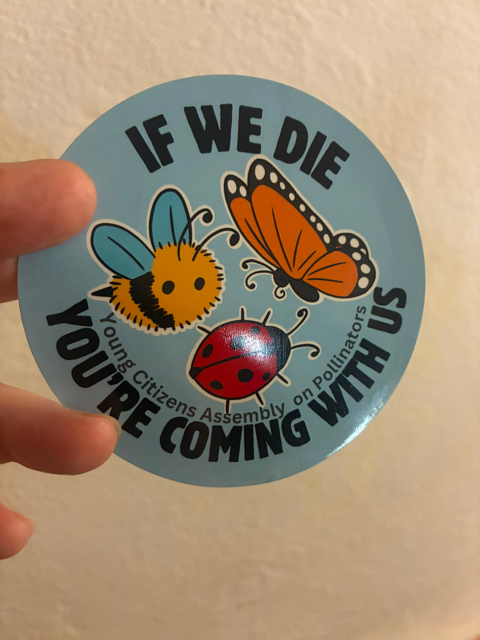
Explore the Assembly’s outputs:
1. Young Citizens’ Assembly on Pollinators – Citizens’ Engagement Platform
Young Citizens’ Assembly on Pollinators – Citizens’ Engagement Platform
2. Main Report
Main Report, containing the citizens’ recommendations, together with the Accompanying Report, which explains the deliberative reasoning behind each proposal.
Main Report with citizens’recommendations
3. Justifications
Explains the reasoning that brought participants to develop specific actions
Accompanying Report with justifications
4. Citizen Engagement and Pollinators Toolkit
Citizen Engagement and Pollinators Toolkit developed by the JRC Competence Centre on Participatory and Deliberative Democracy
See also:
- On a Permanent Assembly, see: Bauböck, Rainer; Nicolaidïs, Kalypso (Ed.): Should a Citizens’ Assembly Complement the European Parliament?, 2025; summary here.
- On Democratic Odyssey: see Guidelines for Itinerant Transnational Citizen Assemblies: Lessons from the Democratic Odyssey
For me, this Assembly is much more than a successful exercise in citizen participation. It offers a glimpse of what a new generation of European democracy could become: one in which young Europeans are not merely consulted on the ecological transition but become its long-term democratic pollinators. I hope this is only the beginning and that the participants can be empowered to make their adventure a permanent feature of the EU in the years to come, as we have advocated.
Contact: kalypso.nicolaidis@eui.eu